

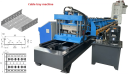

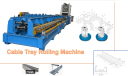
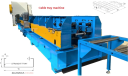


This document is designed for universal cold bending machines used with C-beams, Z-beams, U-beams, and purlins. It categorizes issues into five major types—defects in finished product formation, feeding system malfunctions, precision cutting errors, mechanical operation failures, and electrical control system failures—and provides corresponding solutions: temporary emergency measures, standard corrective actions, and preventive maintenance plans, making it ideal for frontline workshop operations.
Malfunction: The finished product exhibits full section torsion, unilateral outward bending, central arching, and cross-sectional angle deviation, making it unable to fit the installation reference.
① Asymmetric left-right gaps and frame misalignment of each forming roll;
② Excessive pressure on a single roll set leading to internal stress imbalance in the sheet;
③ Improper distribution of bending angles across forming passes, resulting in excessive deformation at the first bend;
④ Uneven thickness and significant hardness variation across batches of raw steel strips;
⑤ Inconsistent height differences between discharge rollers causing inclined loading during material discharge.
Emergency procedure: Stop operation to calibrate the bilateral gaps of each roll set, ensuring consistent roller clearances on both sides at the same workstation; make fine adjustments to unilateral pressure relief and release internal stresses in the sheet metal.
Rectify and reform: Level all forming frames using a level; adjust the coaxiality of the drive shaft; reconfigure the bending path angles; reduce the deformation amplitude in the initial bending stage.
Prevention: Standardize the material and thickness tolerances of the feeding steel strip; adjust the height of discharge rollers, and install limiters and anti-deviation guide wheels.
Fault phenomenon:The steel profile flanges vary in height and length; the bending angles are either too large or too small; the opening dimensions exceed tolerance limits, resulting in batch-wide nonconformities.
① Roll wear, surface chamfering, or deformation;
② Loose roll locking bolts causing operational displacement;
③ Misalignment of feed guide plates resulting in improper steel strip feeding;
④ Fluctuating servo feed speed leading to unstable forming forces.
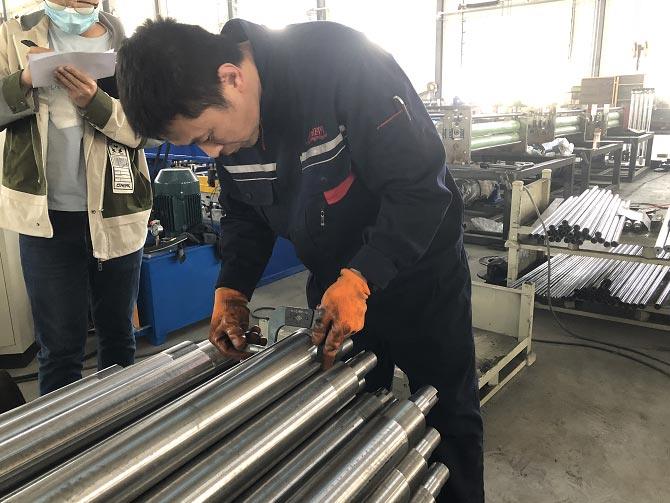
Testing:Measure the finished cross-section section by section using a caliper, compare it with the roller at the most worn position, and mark the replacement point.
Rectify and reform :Tighten all roller lock nuts and frame mounting bolts; recalibrate the feeding guide plate to center it; grind or repair lightly worn rollers, and replace severely worn rollers with matching tooling rollers.
Paramètres :Standardize the feeding speed across the entire line; prohibit frequent switching between high and low speeds during molding.
Fault phenomenon:Continuous scratches on both sides of the steel strip, punctate pressure pits, and galvanization layer detachment, compromising both corrosion resistance and appearance.
① Iron chips, welding slag, and oxide scale adhere to the roller surface;
② The roller surface is corroded with burrs and sharp edges;
③ The guide wheel lacks sufficient hardness, causing jamming and material scraping;
④ Lubrication-free forming results in dry friction-induced damage to the plate surface.
Daily:Stop the machine to clean all roller and guide wheel surfaces of metal chips and impurities, then use an oil stone to remove surface burrs.
Rectify and reform :Replace the damaged guiding nylon wheel to prevent severe metal friction; apply specialized forming lubricant to galvanized steel profiles during molding.
Management and control:During raw material intake and storage, remove oxide slag from the steel strip surface; install a dust removal and slag scraping plate before feeding.
Fault phenomenon:wrinkling occurs at the rounded corners of bending, with localized blistering on the plate surface; this phenomenon is highly prevalent in thin-walled steel sections.
Cause&Solution:Excessive roller pressing force → Reduce the rolling stroke per station; Insufficient bending radius → Replace with a roller featuring larger radius; Excessive feeding tension → Release the material feeding/discharging damping device
Cause:The feed guide groove is eccentric; the pressure from the upper and lower rollers is uneven on both sides; the wound coil is eccentric; and the ground frame is tilted.
Solution:Adjust the bilateral feed guide plates centrally; evenly adjust the pressure adjustment spring of the feed roller; install a centering and tightening device on the material roll; re-level the equipment base.
① The gap between the first forming roller is too small;
② Waste material from irregular edges or corners is trapped within the roller gap;
③ The overlap thickness of steel strip joints exceeds the specified limit;
④ The speed ratio between the feeding motor and the forming roller is incorrect.
Solution:Increase the gap between the initial forming rolls; perform scheduled cleaning of waste materials at the processing station; grind and flatten steel strip joints before feeding; ensure electrical control synchronization between feeding speed and forming rotation speed; install an overload-based reverse feeding program.
Cause:The shipping roller exhibits smooth wear, insufficient pressing force, and oil contamination on its surface; the steel belt surface also becomes slippery due to oil contamination.
Solution:Polish the surface of the feed roller and adjust the clamping pressure; wipe off oil stains from the roller surface and steel belt; replace worn rubber rollers with anti-slip patterned rollers.

Cause:Encoder offset; loss of counting parameters; displacement caused by feeding slip; zero point offset of the cutting servo; incorrect modification of PLC length parameters
Solution:Encoder offset; loss of counting parameters; displacement caused by feeding slip; zero point offset of the cutting servo; incorrect modification of PLC length parameters
Cause:Excessive clearance between the upper and lower cutting blades; dulled cutting edges; failure to adjust clearance when cutting steel of varying thicknesses; excessively high hydraulic descent speed causing impact on the cutting edge.
Solution:Fine-tune the cutting blade fit clearance; grind and polish the cutting edge; replace the alloy cutting blade; set the cutting gap according to thickness requirements; adjust the hydraulic throttle valve to reduce the downward cutting speed.
Cause:Misalignment of punching die; wear of die core; failure to center the profile after forming; excessive hydraulic punching pressure
Solution:Ibrate the punching die for coaxiality; install a punching limit fixture; replace the worn punch and die; reduce the hydraulic pressure for punching
Chain abnormal noise:Chain slack, oil deficiency, tooth wear → Tension the chain, apply gear oil, replace worn sprockets
Abnormal noise at the roller shaft station:Lubrication deficiency in the bearing, damaged balls, excessive clearance in the bushing → Replace the bearing and apply high-temperature resistant grease.
Load friction noise:Rolls are misaligned and rub against each other; the profile also rubs against the frame → The parallelism of the roller assembly needs to be recalibrated.
Cause:Coaxiality deviation of the drive shaft; loose coupling; aging of the base shock absorber pads; uneven force distribution across multiple roller sets; loose motor mounting bolts
Solution:Ibrate the drive shaft concentricity and tighten the coupling; replace the shock-absorbing foot pads; evenly distribute forming pressure across all stations; tighten the bolts on the main motor base.
Cause:Aging of the oil seal ring, insufficient hydraulic oil level, clogged filter element, wear of the hydraulic pump, and failure of the relief valve pressure regulation.
Solution:Replace all oil seal rings; add hydraulic oil of the same grade with wear-resistant properties; clean the hydraulic filter element regularly; adjust the operating pressure of the relief valve; replace the hydraulic pump directly when pressure attenuation occurs in the pump body.

Cause:Excessive load during forming operation; mismatched motor power; insufficient current limiting parameters in the frequency converter; aging wiring causing short circuits; motor stalling due to jammed workstations.
Solution:Reduce the pressure on individual rolls; increase the overload protection threshold of the frequency converter; inspect the power circuit; install an overload shutdown protection program for machine idling.
Cause:Electromagnetic interference in the workshop, loose wiring on the panel, malfunctioning PLC program, and unstable power supply voltage.
Solution:Install shielding grounding wires on the electrical control cabinet; secure communication wiring terminals; power down and restart the PLC for reset; install a voltage stabilizer to accommodate fluctuating workshop voltages.
Cause:The travel switch is blocked by metal shavings; the wiring is broken; and the contacts are oxidized.
Solution:Clean the sensor contact points; replace the waterproof limit switch; regularly check the safety circuit's operation.
Daily pre-shift tasks: Clean iron debris from the rolls, check hydraulic fluid level, and test the emergency stop limit function.
Weekly: Apply grease to chains and bearings, and verify the dimensional accuracy of all profiles.
Monthly: Adjust the rack level, tighten all vehicle bolts, and calibrate the encoder's zero point.
Material control: The use of steel strips with thickness deviations, excessive joint overlap, or severe corrosion is strictly prohibited during production.